
The Math Problem That Broke “Random”
One circle, one triangle, one random line, and three different answers that are all correct.
Imagine a circle. Inside it, draw an equilateral triangle so that its three corners touch the edge.
Now draw a straight line across the circle (a chord) completely at random. What is the probability that your random chord is longer than a side of the triangle?
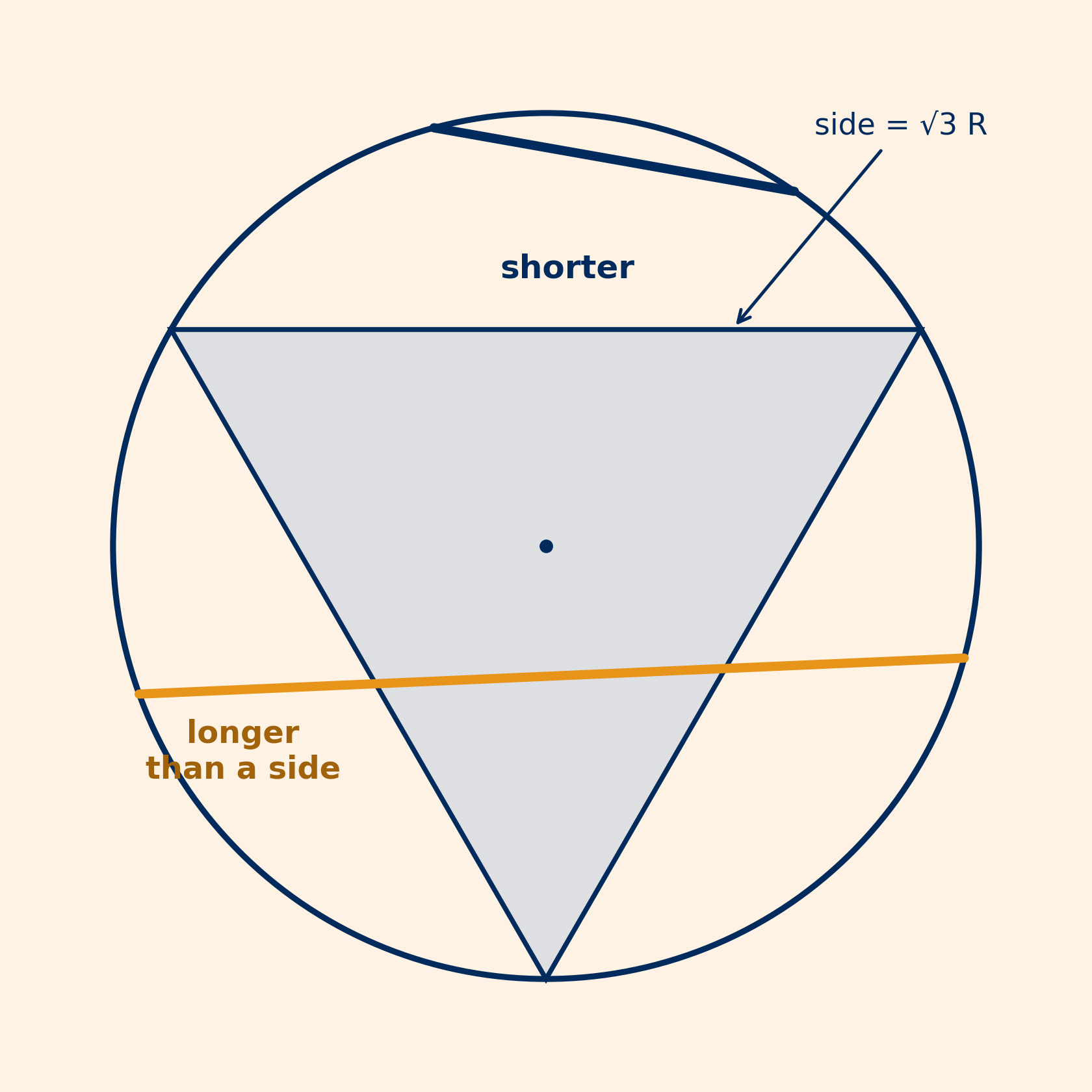
It sounds like a simple question. It is actually a trap, first set by the French mathematician Joseph Bertrand in 1889, and it exposes something we rarely stop to think about. Depending on what you mean by the word “random,” you get three different answers, each backed by flawless mathematics.
Three Programmers, Three Pictures
Suppose three programmers are each asked to “draw a random chord” and each writes a different, perfectly reasonable program. Here is what 450 chords from each program look like, with the long chords in orange.
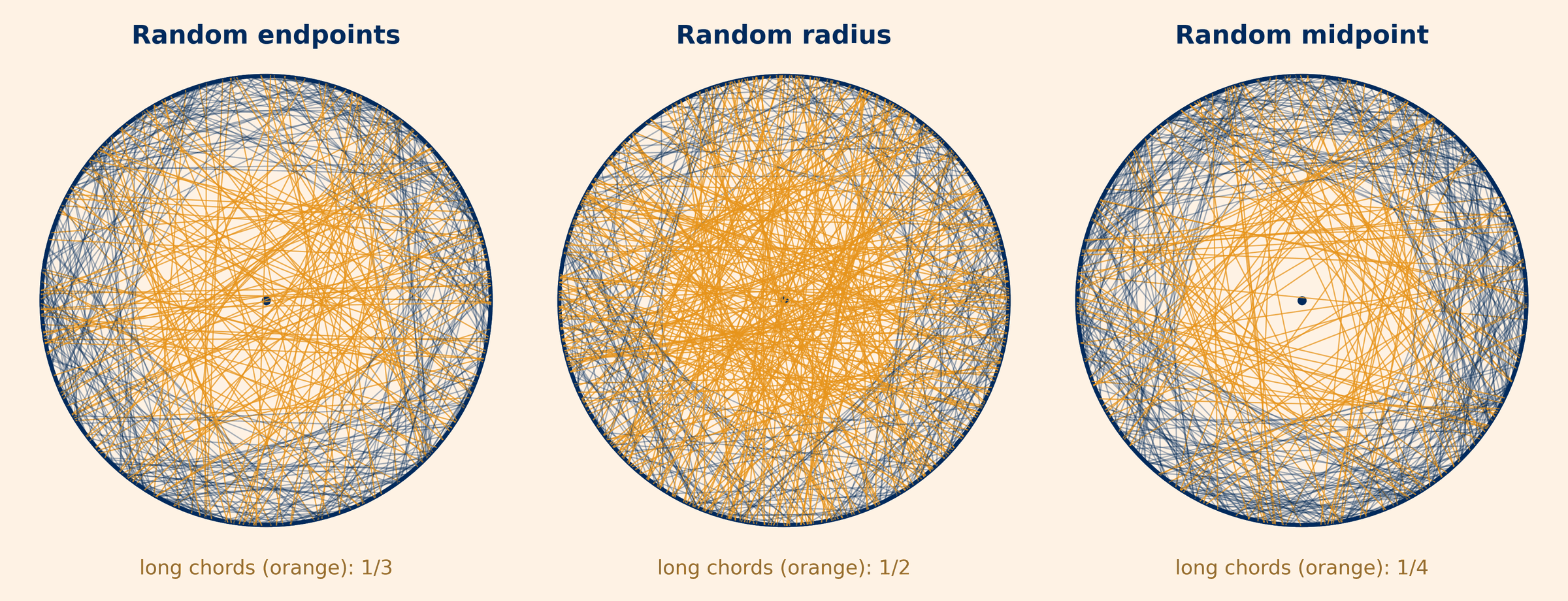
The three pictures are not the same. Let us see where each answer comes from.
A Useful Trick: Rotate the Triangle
Each method below starts by picking something at random: a point on the edge, or a direction for a radius. That random choice will almost never line up neatly with the triangle. But the triangle can be turned. Rotating it about the centre changes no lengths at all, so after each random choice we are free to rotate the triangle into whatever position makes the picture easiest to read. We will use this trick twice.
Method 1: Random Endpoints
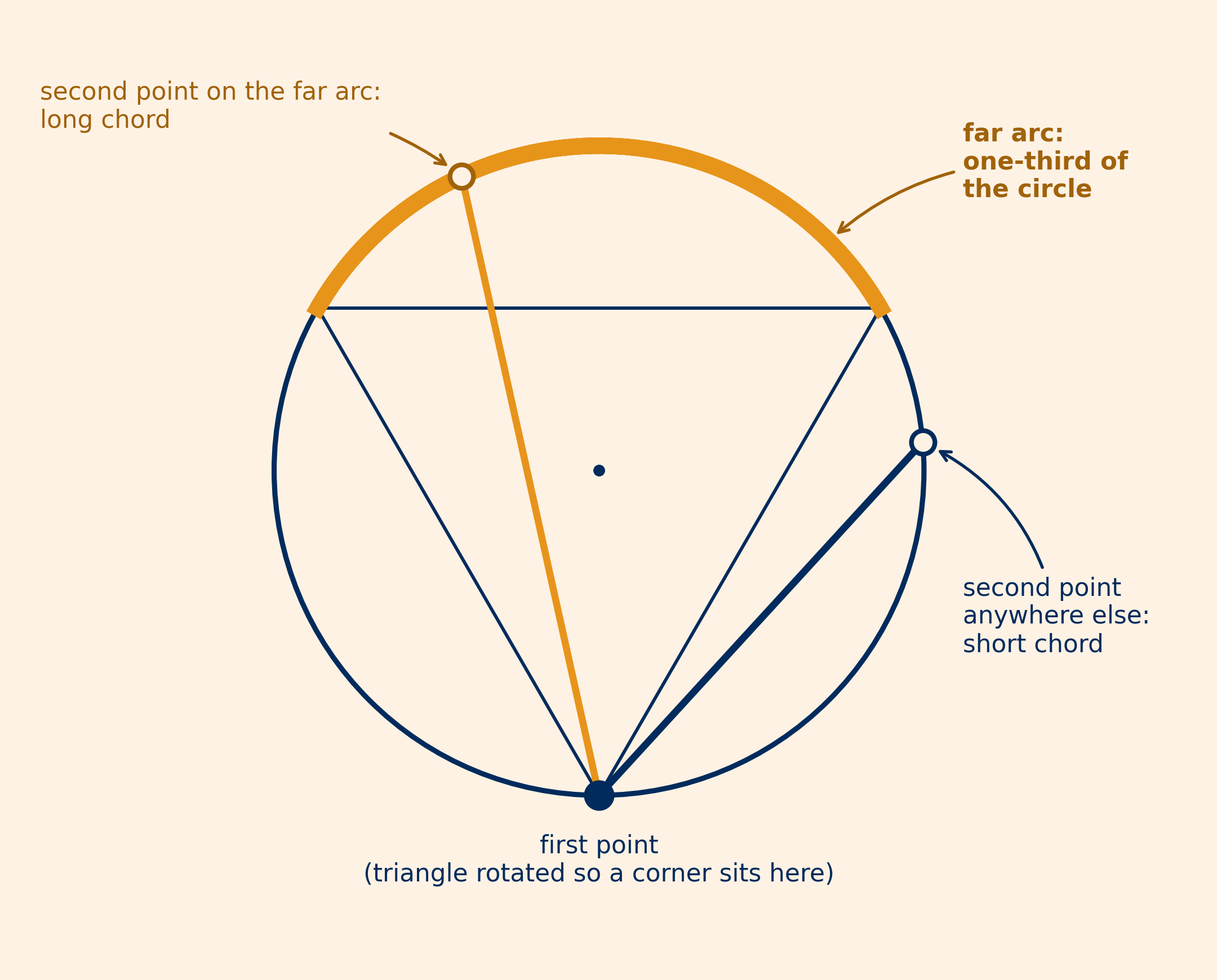
The first programmer picks two random points on the edge of the circle and joins them.
Wherever the first point lands, rotate the triangle so that one of its corners sits exactly there. Now look at the chord from that corner to the second point. It is longer than a side of the triangle only if the second point lands on the far arc, between the other two corners. The three corners split the circle into three equal arcs, so that far arc is exactly one-third of the edge.
P_1 = \frac{1}{3}
Method 2: Random Radius
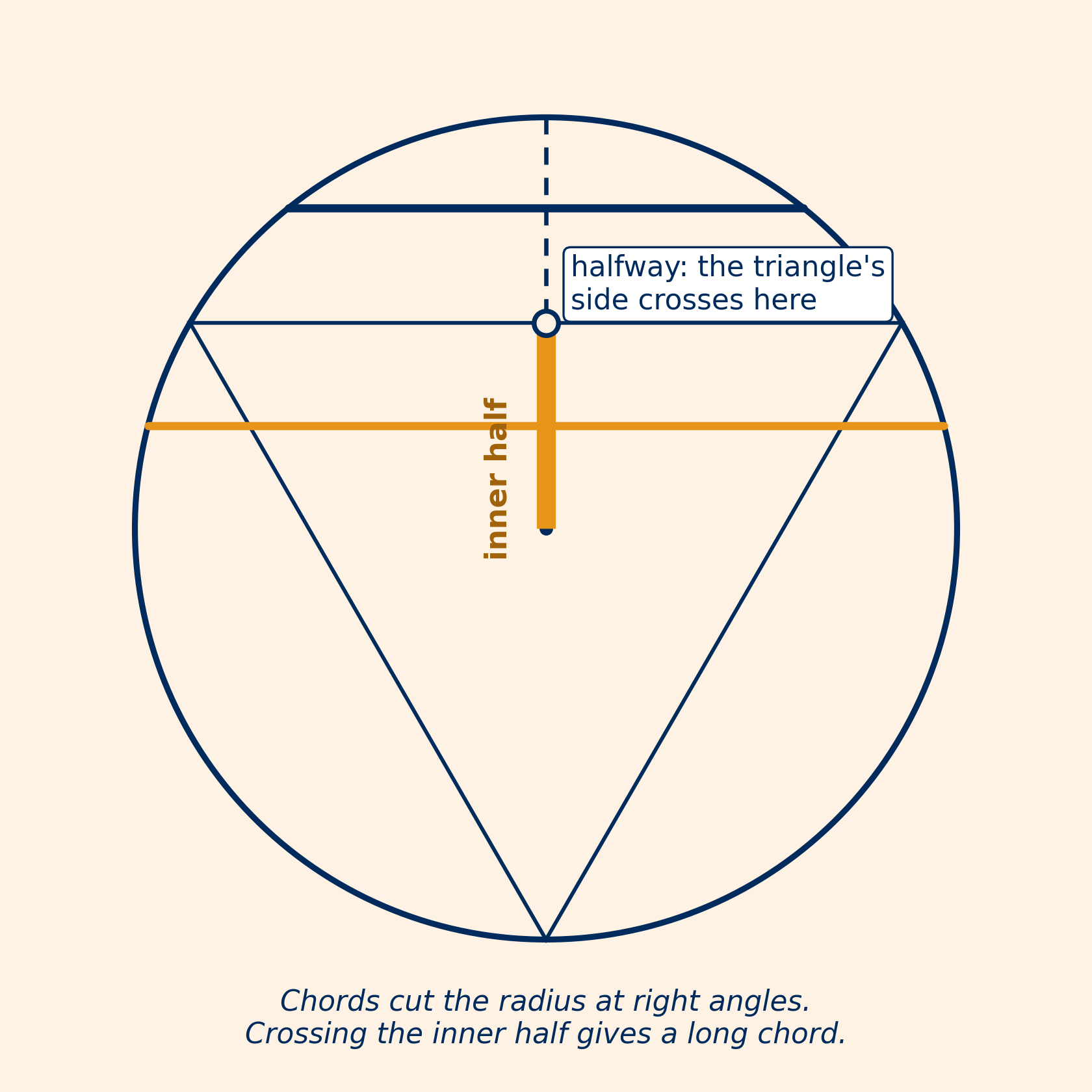
The second programmer draws a radius in a random direction, picks a random point along it, and draws the chord through that point at right angles to the radius.
This time, rotate the triangle so that one of its sides is perpendicular to the chosen radius. That side then crosses the radius at exactly its halfway mark. (The centre of the circle is also the centre of the triangle, which sits two-thirds of the way down each altitude. The altitude is \tfrac32 R long, so the centre is R from each corner and \tfrac12 R from each side.)
A chord crossing the radius closer to the centre than that side is longer than the side; a chord crossing farther out is shorter. So the chord is long exactly when the random point lands on the inner half of the radius.
P_2 = \frac{1}{2}
Method 3: Random Midpoint
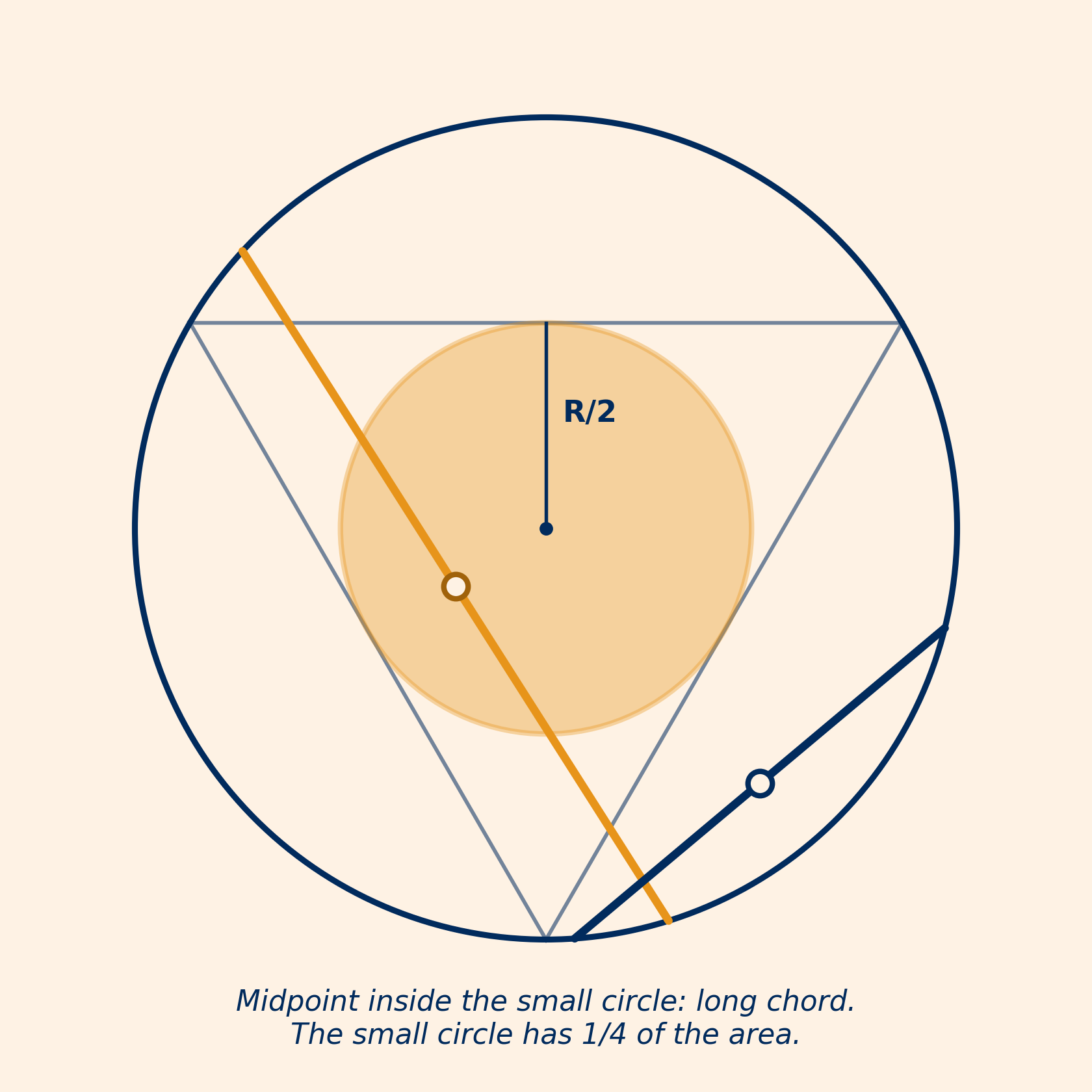
The third programmer says a chord is determined by its midpoint. They pick a random point anywhere in the area of the circle and draw the one chord that has that point as its middle.
The chord’s distance from the centre is simply its midpoint’s distance from the centre. By the same reasoning as Method 2, the chord is long exactly when that distance is less than \tfrac12 R, that is, when the midpoint falls inside a smaller circle of radius \tfrac12 R. (That small circle is exactly the circle that fits snugly inside the triangle.) Its area compared with the big circle is
P_3 = \frac{\pi\,(R/2)^2}{\pi R^2} = \frac{1}{4}.
Is There a Best Answer?
The story does not quite end at “everyone is right.” In 1973 the physicist E. T. Jaynes asked a more physical question: what happens if you actually toss long straws onto a circle drawn on the floor? He argued that the answer should not change if the circle is moved slightly or drawn a little larger or smaller, and that this requirement singles out Method 2. Tossed straws, he predicted, would give \tfrac12. The debate over whether his argument settles the paradox continues, and his paper, The Well-Posed Problem, is well worth looking up.
Why Did Our Earlier Puzzles Work?
In The Geometry of a Missed Connection, we drew a square and simply declared that every point in it was equally likely. In the broken-stick problem, we did the same. Why was that safe there, when it falls apart here?
Because in those problems, the question itself named the random quantity. Alice and Bob each arrive at a uniformly random time, and the two axes of our square were those arrival times. The stick was broken at uniformly random positions, and the square’s axes were those positions. “Every point is equally likely” was not an extra assumption we slipped in; it was the problem statement, redrawn as a picture.
Bertrand’s question names no such quantity. “A random chord” does not say whether the endpoints, the distance, or the midpoint should be spread evenly, so the problem has no single answer until we decide.
Before measuring any area, ask which quantity the problem says is random. Once that is fixed, the geometry takes care of the rest.