
The Geometry of a Missed Connection
Two friends, one hour, and a fifteen-minute fuse. Turn time into a square, and the odds draw themselves.
Two friends, Alice and Bob, agree to meet at a local café sometime between 12:00 PM and 1:00 PM. Each will arrive at a completely random time within that hour.
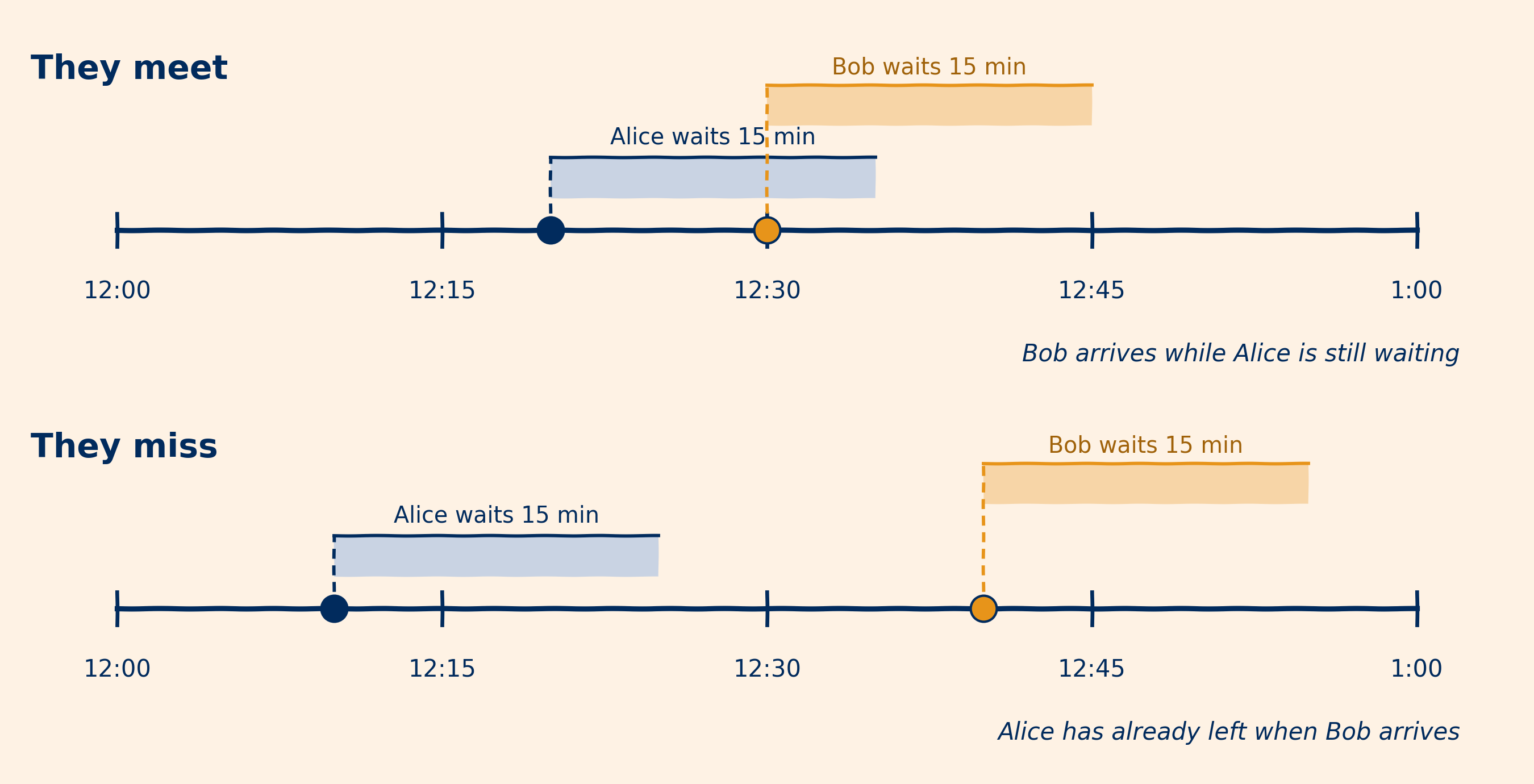
Neither of them is especially patient. Whoever arrives first will wait exactly 15 minutes. If the other person hasn’t shown up by then, they leave.
What are the chances they actually get their coffee together?
The Trap
At first, this sounds like a nightmare of moving targets. Alice’s and Bob’s arrival times are completely independent of each other; neither one knows or cares when the other shows up. But whether they meet depends on both times at once, and the 15-minute window slides along with whoever happens to arrive first. Trying to track that sliding window with brute-force arithmetic or case-by-case calculus feels like trying to nail jelly to a wall.
But if we stop treating this as a problem about time and start treating it as a problem about space, the answer simply draws itself.
Mapping Time to Space
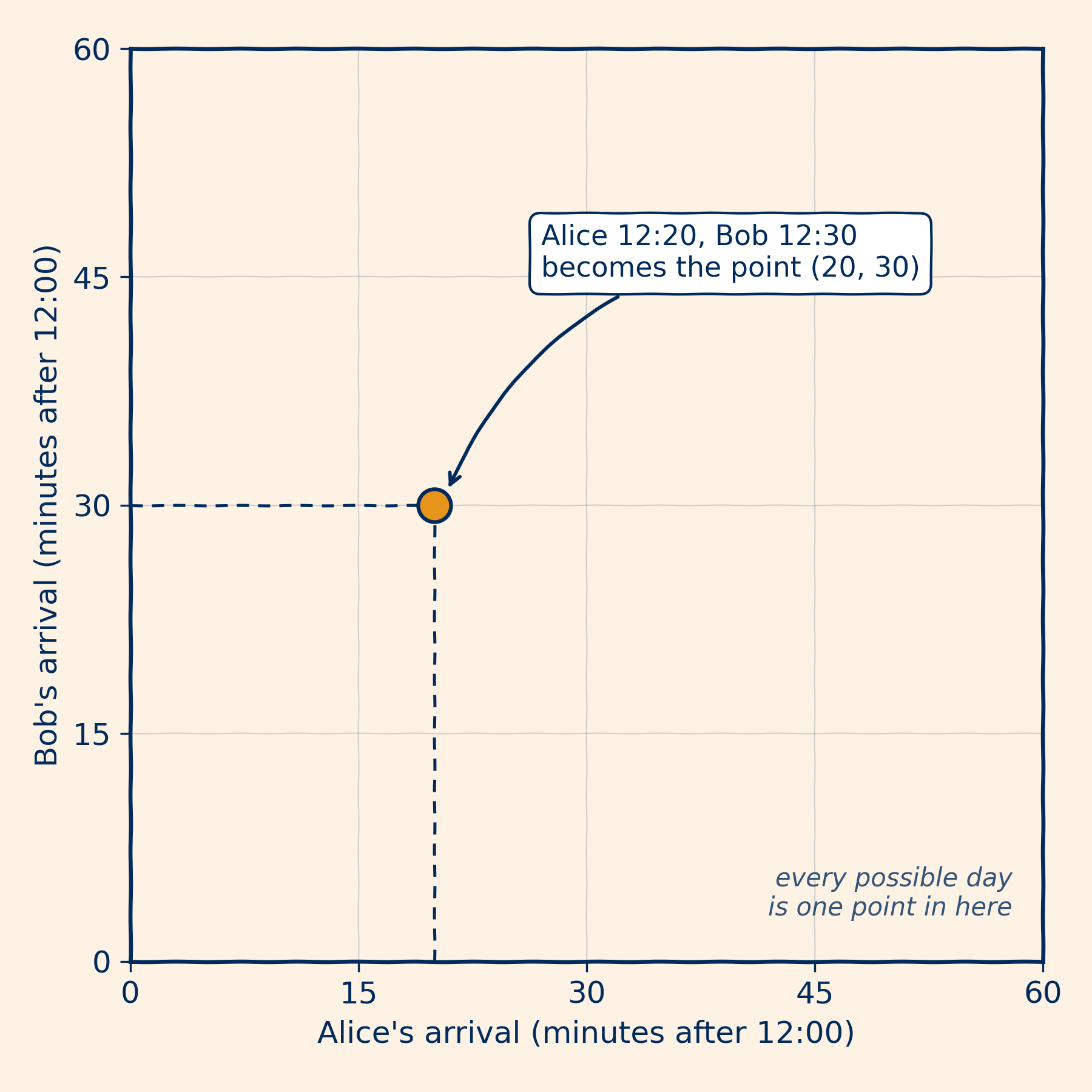
Imagine a square graph. Let the horizontal axis be Alice’s arrival time, measured in minutes after 12:00, from 0 to 60. Let the vertical axis be Bob’s arrival time, also from 0 to 60.
Every possible pair of arrival times is now just a single point inside this 60 \times 60 square. If Alice arrives at 12:20 and Bob at 12:30, that whole lunch hour becomes the point (20, 30). Because both arrivals are independent and uniformly random, every point in the square is equally likely, so probability becomes a matter of measuring area. The total area is
60 \times 60 = 3600.
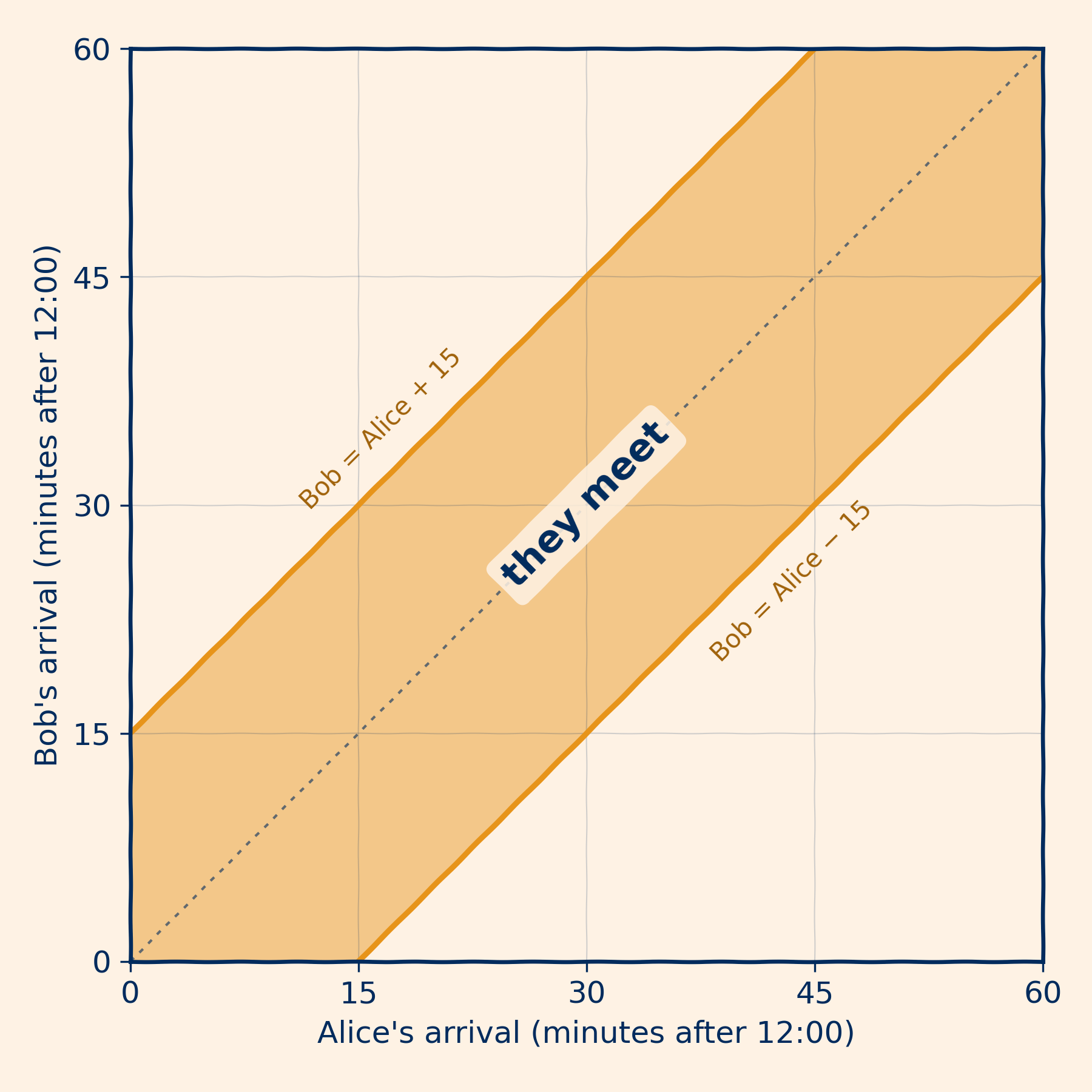
When do they actually meet? Exactly when the gap between their arrival times is 15 minutes or less:
|x - y| \le 15,
where x is Alice’s arrival and y is Bob’s. On our graph, this “safe zone” is a diagonal strip running from the bottom-left corner to the top-right, bounded by the lines y = x + 15 and y = x - 15.
The Corners of Failure
Measuring that diagonal strip directly is a bit awkward. Measuring the region where they fail to meet, however, is easy.
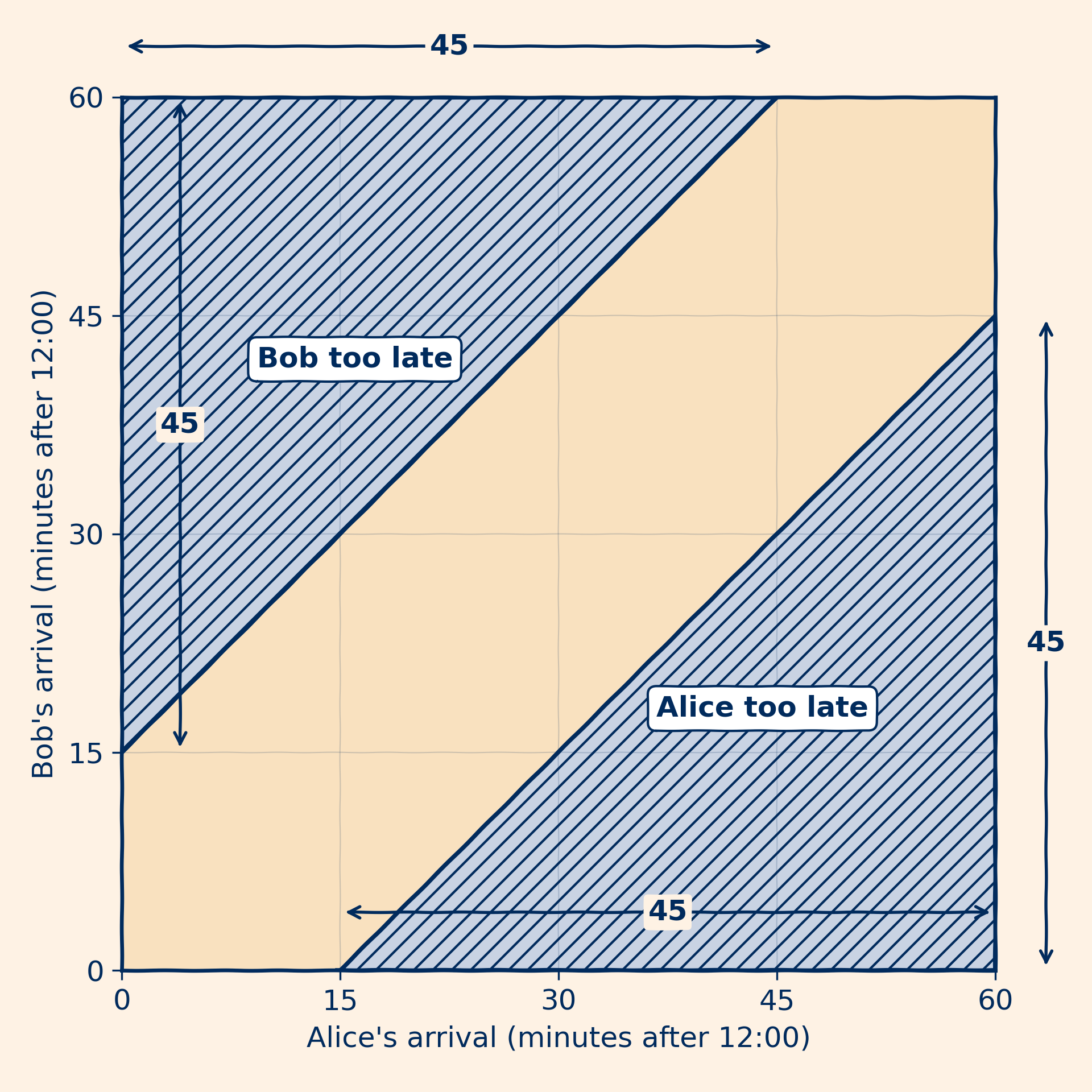
The parts of the square outside the strip form two right triangles, one in the top-left corner and one in the bottom-right:
- The top-left triangle is where y > x + 15: Bob arrives more than 15 minutes after Alice. Bob is too late, and Alice has already left. Both of its legs are 45 minutes long.
- The bottom-right triangle is where x > y + 15: Alice arrives more than 15 minutes after Bob. Alice is too late. It also has two legs of 45 minutes.
The area of each triangle is half its base times its height:
\tfrac{1}{2} \times 45 \times 45 = 1012.5.
Together, the total “failure area” is 2 \times 1012.5 = 2025.
The Answer
To find the success area, subtract the failures from the whole square:
3600 - 2025 = 1575.
Divide that favorable area by the total area:
P(\text{meet}) = \frac{1575}{3600} = \frac{7}{16} = 43.75\%.
By turning time into a square, a moving-target probability problem reduces to finding the area of two triangles. No calculus required.
Chasing the Extremes
Before trusting any answer, it helps to push the problem to its limits and see whether the picture still makes sense.
What if neither friend waits at all? Then they meet only if they arrive at exactly the same instant. The strip shrinks to the thin diagonal line y = x, which has no area. The two failure triangles swell until they fill the entire square. The probability of meeting is 0.
What if each friend is willing to wait the full 60 minutes? Then whoever arrives first is still sitting there when the other walks in, no matter what. The strip widens until it swallows the whole square, the failure triangles shrink to nothing, and the probability is 1.
So as patience grows from 0 to 60 minutes, the chance of meeting climbs steadily from certain failure to certain success, and a 15-minute wait lands them at 7/16, just short of a coin flip.
Your Turn
Replace the 15 minutes with any waiting time w, anywhere from 0 to 60. What is the probability that Alice and Bob meet now? Your two failure triangles still do all the work, and your formula should agree with both extremes above.
And once you have it, one more question. How patient do Alice and Bob need to be to have a better than even chance of getting that coffee?