
Snap a Stick in Two Places. What Are the Odds You Get a Triangle?
Imagine a perfectly straight stick.
Pick two points at random along its length. Snap it at both. You now have three pieces.
Lay them end to end. Do they close into a triangle?
Sometimes they will. Sometimes they won’t. The interesting question is: how often?
The perfect break
When most people first meet this problem, the mind reaches for the most symmetric answer: break the stick into three equal pieces.
If the stick is 3 metres long and you snap it at the 1-metre and 2-metre marks, you get three pieces of 1 metre each. Do they form a triangle? Absolutely — a perfect equilateral one.
So at least one break works. Which raises the real question: what else works?
To find out, it helps to look at the opposite extreme — a break that fails completely.
The terrible break
Snap the stick so that one piece is enormous — say 90% of the total length — leaving two tiny fragments.
Lay the long piece flat and attach the two fragments to its ends. They dangle. They can never reach across the gap to meet each other.
Put the two breaks side by side and a rule starts to emerge:
For the pieces to connect, no single piece can be too long.
“Too long” is doing a lot of work in that sentence. Let’s make it precise.
The detour rule
Think of two points, A and B, as two towns.
The edge |AB| is the straight road between them — and the straight road is always the shortest one. The path from A to C and then C to B is a detour. It has to be longer.
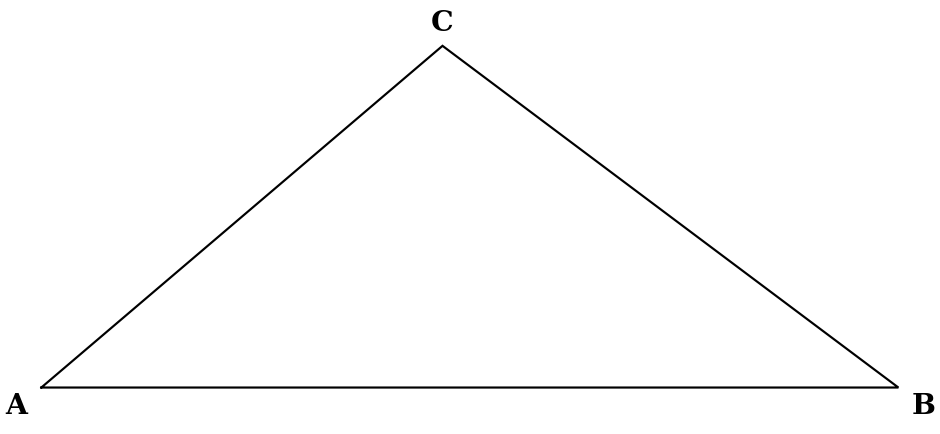
That is the whole idea:
|AC| + |CB| > |AB|
Two sides of a triangle, added together, must exceed the third. And since any of the three sides could play the role of “the straight road,” this has to hold for all three pairings at once.
Mathematics has a name for this: the triangle inequality.
Testing it on the terrible break
Take a 3-metre stick. The huge piece is 2.7 metres, and the two fragments are 15 cm each.
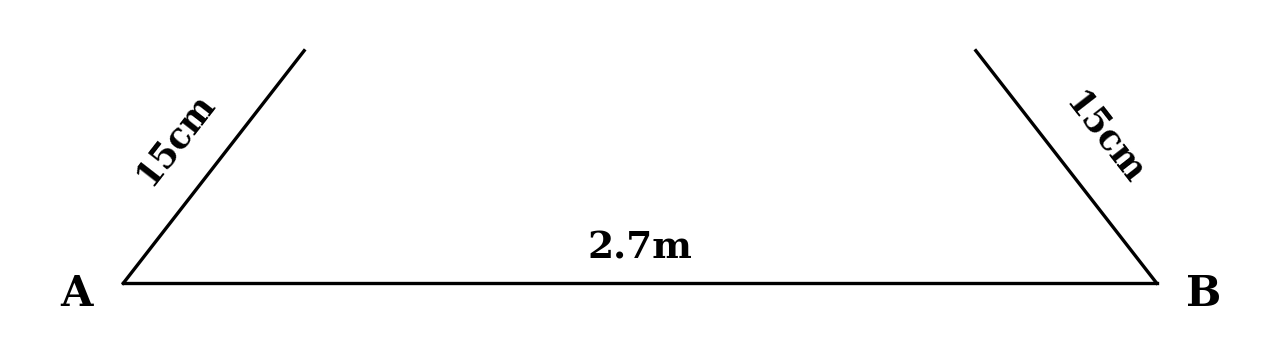
Here |AB| = 270 cm, |AC| = 15 cm and |CB| = 15 cm. Check the pairing that involves the two short pieces:
15 + 15 = 30 \not> 270
It fails. And one failure is enough — the triangle inequality has to hold for every pairing, not just a convenient one. The other two pairings do hold here (270 + 15 is comfortably more than 15), but that rescues nothing. A chain breaks at its weakest link.
The breaking point
So where exactly is the boundary between “works” and “fails”?
The three pieces always add up to the whole stick — 100% of it. So ask: what if the longest piece is exactly half?
Then the other two pieces add up to exactly half as well. Try to build the triangle and they lie perfectly flat along the long piece. Two sides collapse onto the third. You get a straight line, not a triangle.
That is the edge. And it gives us the golden rule:
A triangle forms if and only if no single piece is half the stick or longer.
Now we can count.
The complete solution
Let the stick have length 1.
Drop two random break points on it. Call the one nearer the left end x, and the other y. So x < y — not because we have restricted anything, but because we are free to choose which label goes where. Both points are chosen uniformly on (0, 1).
This gives three pieces:
a = x, \qquad b = y - x, \qquad c = 1 - y
And of course a + b + c = 1.
Applying the triangle inequality
Three conditions must hold at once:
a + b > c, \qquad a + c > b, \qquad b + c > a
Here is the elegant part. Take the first one. Since the three pieces sum to 1, we know that a + b = 1 - c. So the condition becomes
1 - c > c \quad \Longleftrightarrow \quad c < \tfrac{1}{2}
The same trick works on all three. Every condition collapses into the same statement about a single piece:
a < \tfrac{1}{2}, \qquad b < \tfrac{1}{2}, \qquad c < \tfrac{1}{2}
The algebra has not given us a new fact. It has handed back our golden rule — three times over. No piece may reach half the stick.
Writing this in terms of x and y
Substituting the piece lengths back in:
\begin{aligned} c < \tfrac{1}{2} \quad &\Longrightarrow \quad 1 - y < \tfrac{1}{2} \quad \Longrightarrow \quad y > \tfrac{1}{2} \\[4pt] a < \tfrac{1}{2} \quad &\Longrightarrow \quad x < \tfrac{1}{2} \\[4pt] b < \tfrac{1}{2} \quad &\Longrightarrow \quad y - x < \tfrac{1}{2} \quad \Longrightarrow \quad y < x + \tfrac{1}{2} \end{aligned}
Three clean inequalities in two variables. Which means we can draw them.
Turning probability into area
Plot the two break points on a graph: x on the horizontal axis, y on the vertical. Both run from 0 to 1, so every possible pair of breaks is a single point somewhere inside a 1 \times 1 square.
But we agreed to always call the smaller number x. So x < y always — and the line y = x, running diagonally from (0,0) to (1,1), splits the square in two:
- Below the line lie the cases where x > y. Our labelling choice threw this half away.
- Above the line lie the cases where x < y. This is our entire universe of possibilities.
That upper-left triangle, shaded green, is our sample space:
\text{sample space} = \tfrac{1}{2} \times 1 \times 1 = 0.5
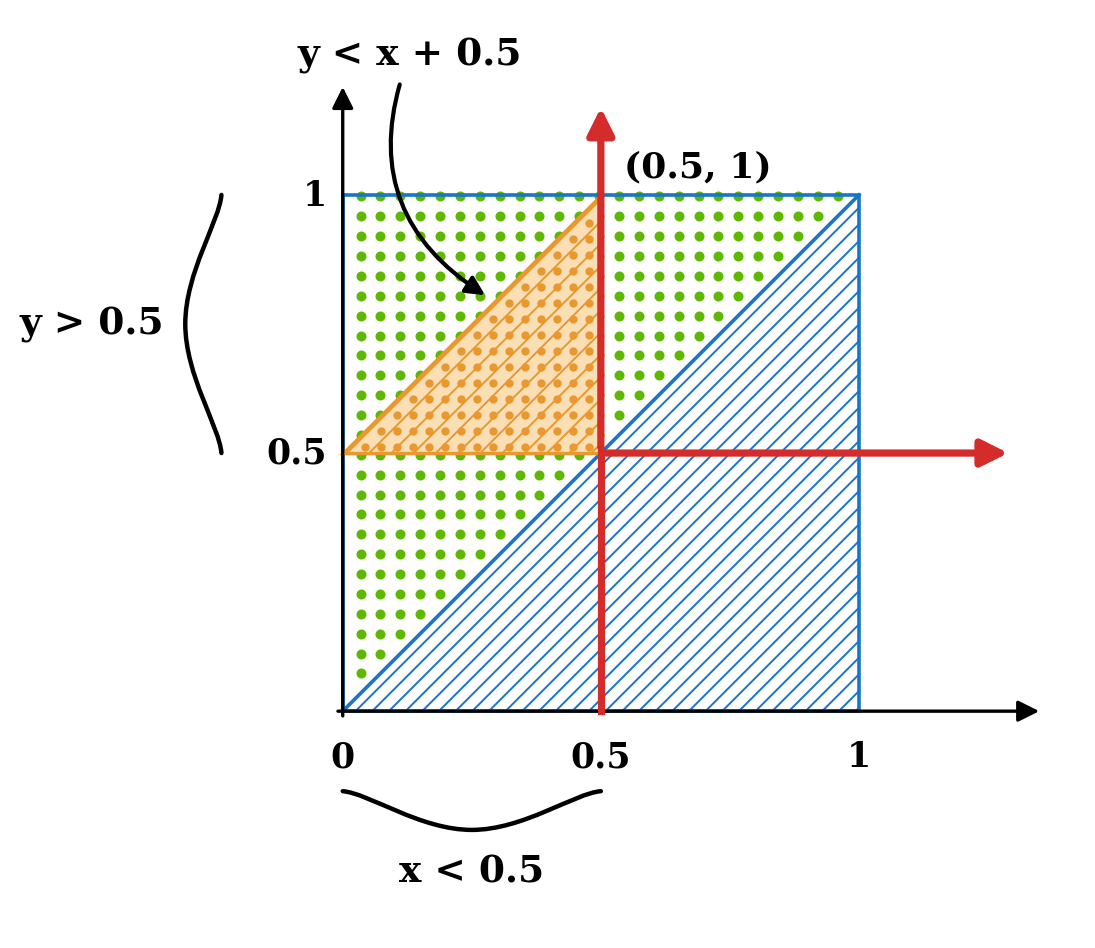
Now shade only the points that satisfy all three conditions — x < \tfrac{1}{2}, y > \tfrac{1}{2}, and y < x + \tfrac{1}{2}. They carve out a smaller triangle with corners at \left(0, \tfrac{1}{2}\right), \left(\tfrac{1}{2}, \tfrac{1}{2}\right) and \left(\tfrac{1}{2}, 1\right), shown in orange. Its two legs are each \tfrac{1}{2} long:
\text{favourable} = \tfrac{1}{2} \times \tfrac{1}{2} \times \tfrac{1}{2} = 0.125
And geometric probability is nothing more than a ratio of areas:
P(\text{triangle}) = \frac{0.125}{0.5} = \frac{1}{4}
One in four
Snap a stick at two random points, and one time in four you can build a triangle from the pieces.
Not one in two. Not one in three. One in four — and notice where the answer came from. We compared the size of two shaded regions. No integrals. No counting. Just area.
That is the quiet power of geometric probability: it takes a question about randomness and turns it into a question about shape.
Before you go
Here is a variant worth sitting with.
Instead of dropping both break points at once, do it in two stages. Break the stick at one random point. Then look at the two pieces, pick the longer one, and break that at a random point.
Same stick. Same three pieces. Same triangle question.
Is the answer still \tfrac{1}{4}?
It is not. And the reason why is worth a post of its own.