
Break the Longer Piece. Does That Help?
Last time we snapped a stick at two random points and asked whether the three pieces would form a triangle. The answer was one in four, and it came out of comparing the areas of two shaded regions on a graph. No calculus. Just shape.
Now change one thing.
Instead of dropping both break points at once, do it in two stages. Break the stick at a random point. Look at the two pieces you have. Pick the longer one, and break that at a random point along its length.
Same stick. Same three pieces at the end. Same triangle question.
Is the answer still one in four?
Why you might expect a lot
There is a good reason to think this should help, and it is worth saying out loud before we compute anything.
A triangle fails when one piece is too long — at least half the stick. In the original problem nothing stops that happening. Both breaks land wherever they like, and quite often they land close together, leaving one enormous piece and two fragments.
The new rule attacks exactly that failure. By always breaking the longer piece, we are deliberately going after the piece most likely to be the culprit. It feels like it ought to fix most of the trouble.
Hold on to that intuition. We will come back to it.
Setting it up
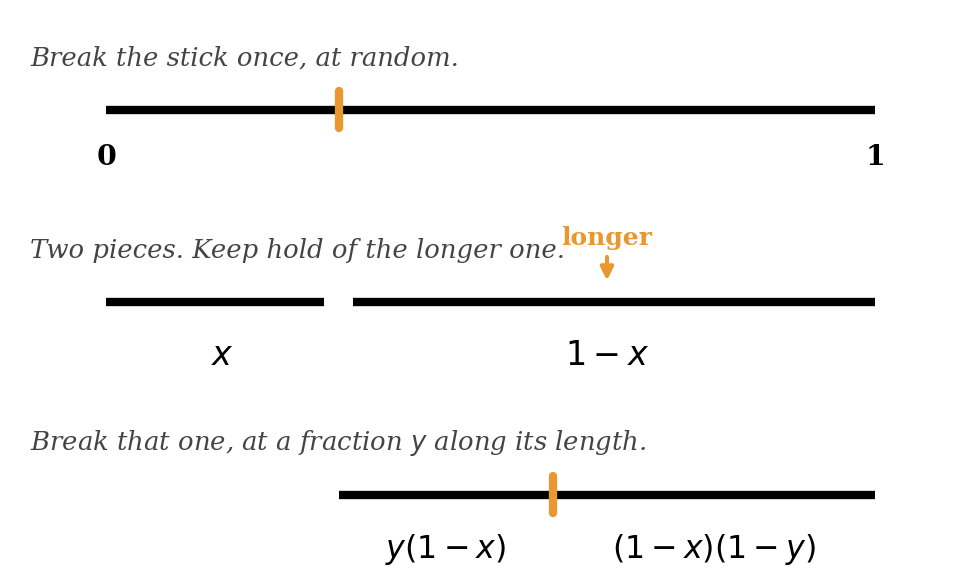
Let the stick have length 1 and let the first break leave a shorter piece of length x. Since it is the shorter piece, x < \tfrac{1}{2}. The longer piece has length 1 - x.
Now for the second break, and here is where the problem gets interesting.
The trap
The obvious move is to copy what worked last time: call the second break point y, write down the three piece lengths, and draw the picture.
Try it. You get pieces x, y and (1-x) - y, the triangle inequality gives you three tidy conditions, and you can shade a region and measure it. It is quick, and it gives an answer of one half.
That answer is wrong, and the reason is worth more than the problem.
Comparing areas only measures probability when every point in the picture is equally likely. In the original problem it was: both breaks were uniform on the same interval, independently. Here they are not. The second break lives on the longer piece, and how long that piece is depends on where the first break landed. A given value of y is not equally available for every x — for small x the long piece is nearly the whole stick, for x near \tfrac{1}{2} it is only half of it.
So the two variables are tangled together, and the area of a region no longer tells us anything about how often we land in it.
Untangling them
There is a fix, and it is a small one. Instead of measuring the second break as a length, measure it as a fraction.
Let y be the proportion of the way along the longer piece where the second break falls, so 0 < y < 1. Whatever the long piece happens to measure, the break is equally likely to fall anywhere along it — so y is uniform on (0,1), and it no longer cares what x is.
The two variables are independent again. The picture will work again.
The three pieces are now
a = x, \qquad b = y(1-x), \qquad c = (1-x)(1-y).
A quick check: they sum to x + (1-x)\left[y + (1-y)\right] = x + (1-x) = 1.
Applying the triangle inequality
Same rule as last time. A triangle forms exactly when every piece is under half. Taking them one at a time, and dividing through by 1-x where it helps:
Piece a. From b + c > a we get (1-x) > x, that is x < \tfrac{1}{2}, which we already knew — the first break always leaves a shorter piece.
Piece c. From a + b > c: x + y(1-x) > (1-x)(1-y) \quad\Longrightarrow\quad \frac{x}{1-x} > 1 - 2y.
Piece b. From a + c > b: x + (1-x)(1-y) > y(1-x) \quad\Longrightarrow\quad \frac{x}{1-x} > 2y - 1.
Look at those last two. They are the same statement twice, once for each sign. A number beats both a quantity and its negative exactly when it beats the absolute value, so together they say
\left|\,2y - 1\,\right| < \frac{x}{1-x}.
Unwrapping the absolute value and tidying up:
\frac{1}{2} - \frac{1}{2}\!\left(\frac{x}{1-x}\right) \;<\; y \;<\; \frac{1}{2} + \frac{1}{2}\!\left(\frac{x}{1-x}\right).
So y has to land in a band centred on \tfrac{1}{2} — cutting the long piece exactly in half — and that band has width
\frac{x}{1-x}.
This is already telling us the story. If the first break barely nicked the end, x is tiny, the band is almost nothing, and you would have to halve the long piece with near-perfect accuracy to get a triangle. If the first break landed near the middle, x is close to \tfrac{1}{2}, the band is the full height, and every second break works.
The picture
Plot x horizontally from 0 to \tfrac{1}{2}, and y vertically from 0 to 1. Every possible outcome is a point in that rectangle, and now — with y measured as a fraction — every point really is equally likely.
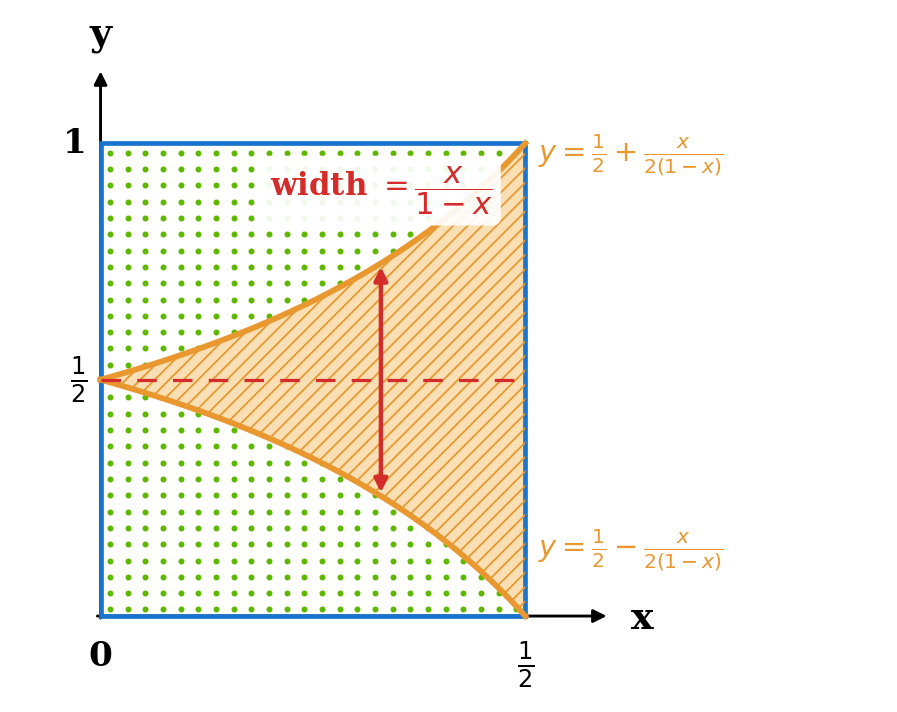
The green rectangle is everything that can happen. The orange band is everything that gives a triangle: pinched to a point at the left, opening to full height at the right.
The rectangle has area \tfrac{1}{2}, and that is what we divide by — the same move as last time. Then, the first break could equally have landed on either side of the middle, and we chose to call the shorter piece x. That convention throws away half of the possibilities, exactly as insisting x < y threw away half the square in the previous problem. So
P(\text{triangle}) = \frac{\text{orange area}}{\tfrac{1}{2}}.
Where the method finally strains
Last time the orange region was a triangle, and the area of a triangle is \tfrac{1}{2}\times\text{base}\times\text{height}. Anyone can finish from there.
This time the edges are curves. The band width \dfrac{x}{1-x} is a hyperbola, and no amount of clever chopping into triangles will give its area. Adding up the widths of infinitely many infinitely thin vertical strips is precisely what an integral does:
\text{orange area} = \int_0^{1/2} \frac{x}{1-x}\,dx.
Substituting u = 1 - x, so that x = 1 - u and dx = -du, and noting that x = 0 gives u = 1 while x = \tfrac{1}{2} gives u = \tfrac{1}{2}:
\int_0^{1/2}\frac{x}{1-x}\,dx = \int_{1/2}^{1}\frac{1-u}{u}\,du = \int_{1/2}^{1}\left(\frac{1}{u} - 1\right)du = \Big[\ln u - u\Big]_{1/2}^{1}.
= (0 - 1) - \left(\ln\tfrac{1}{2} - \tfrac{1}{2}\right) = \ln 2 - \tfrac{1}{2} \approx 0.1931.
Dividing by the sample space:
P(\text{triangle}) = \frac{\ln 2 - \tfrac{1}{2}}{\tfrac{1}{2}} = 2\ln 2 - 1 \approx 0.3863.
About two in five
So the answer moved from 0.25 to roughly 0.386.
It did help. Deliberately attacking the piece most likely to ruin things does improve your odds, by more than half again. But look how modest that is against the intuition we started with. The new rule felt like it should fix most of the failures. It fixes a little over a third of them, and the majority of attempts still end with three pieces that will not close.
The reason is visible in the picture. Breaking the longer piece protects you against one failure — the long piece staying long — but it does nothing about the other. If the first break leaves a very short piece, that piece is already too short to reach across, and no amount of care with the second break can rescue it. That whole left-hand region of the rectangle is lost before the second break is even made.
The fingerprint
One last thing, and it is the part I like most.
The answer contains a logarithm. Snap a stick, snap it again, and \ln 2 falls out.
Logarithms do not come out of the areas of triangles. They cannot. If your region has straight edges, you can always finish with school geometry and you will always get an answer built from ordinary arithmetic. The moment a logarithm appears, it is proof that something curved was involved.
So that \ln 2 is not decoration. It is a fingerprint — evidence, left at the scene, that this problem was never going to yield to the method that solved the first one. And you could have predicted it before computing anything, simply by noticing that the width of the band was \dfrac{x}{1-x} rather than something straight.
That is worth carrying forward. The shape of an answer often tells you what kind of argument had to produce it.